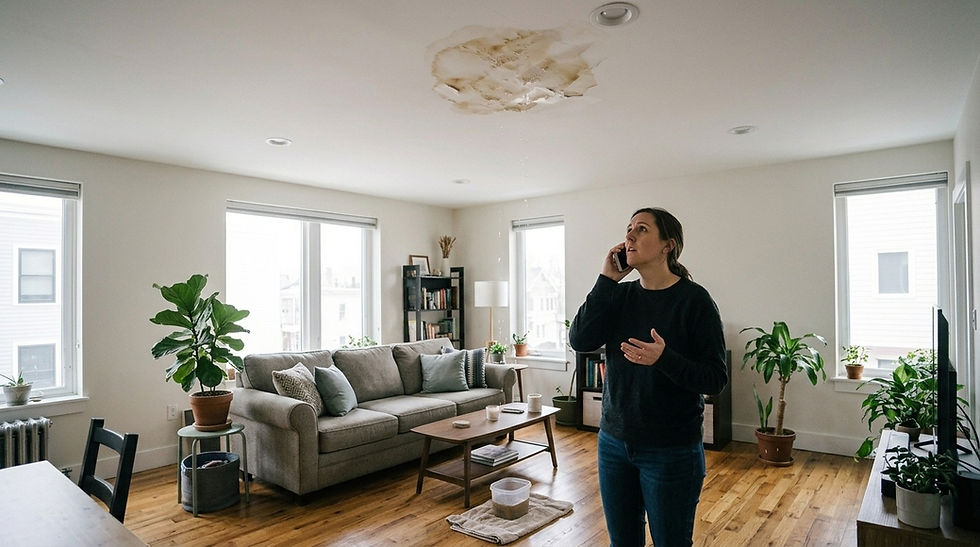
How Much Is a Water Damage Claim Worth? Average Payouts, Real Ranges, and What Drives Your Settlement

Tl;dr
The average water damage and freezing claim is worth about $15,400, according to Insurance Information Institute data covering 2019 through 2023. Real settlements range from under $1,000 for a contained leak to more than $50,000 for a multi-room loss.
The spread is that wide because your payout depends less on how wet your house got and more on four things: the cause of the loss, whether your policy pays actual cash value or replacement cost, your policy sublimits, and how thoroughly the damage was documented before repairs began.
How Much Is The Average Water Damage Claim Worth?
The average water damage insurance claim is typically worth $12,000 to $15,400, depending on how the data is measured.
According to the Insurance Information Institute (Triple-I), using ISO and Verisk claims data, water damage and freezing claims averaged about $15,400 between 2019 and 2023, up from $13,954 in the previous reporting period as labor and material costs increased.
Consumer-focused analyses generally report lower averages, around $12,000 to $12,500, because they reflect final claim payouts after deductibles and depreciation, while insurer data also includes claim reserves.
That difference is why a national average is only a starting point. The value of your claim depends far more on the cause of the damage, the extent of repairs, your policy limits, and your deductible than on any published average.
For context, water damage causes about $13 billion in insured losses each year, and roughly 1 in 67 insured homes files a water damage or freezing claim annually.
Water Damage Payout Ranges By Severity
Here is a more useful way to think about value. Find the row that matches your loss.
Scenario | Typical damage scope | Typical payout range | Where money commonly gets lost |
Supply-line or appliance leak, single room | Flooring, baseboard, drywall, limited drying | $1,500 – $6,000 | Drying and demolition labor omitted from the scope |
Burst pipe, multiple rooms or a finished basement | Structural drying, drywall replacement, flooring, cabinetry, contents | $8,000 – $25,000 | Contents undervalued; additional living expenses never claimed |
Long-term hidden leak behind a wall or under a slab | Concealed rot, mold remediation, structural repair | $5,000 – $30,000+ | Denied outright as gradual damage or maintenance |
Sewage or Category 3 backup | Full remediation, contents disposal, sanitization, rebuild | $10,000 – $40,000 | Sewer backup sublimit caps the claim well below the loss |
Whole-floor or whole-home loss | Full rebuild, contents, extended displacement | $40,000 – $100,000+ | Depreciation never released; ALE cut short |
These are settlement ranges, not repair estimates. The difference between the two is where a claim is won or lost.
The 7 Factors That Actually Determine Your Payout
Cause of loss: sudden versus gradual: Standard homeowners policies cover water damage that is sudden and accidental. A pipe that bursts is covered. A pipe that has been weeping behind a wall for eight months is frequently denied as gradual damage or lack of maintenance. This single distinction decides more water claims than any other.
Water category: Clean water from a supply line (Category 1) is the cheapest to remediate. Grey water from an appliance discharge (Category 2) raises the scope. Black water from sewage or flooding (Category 3) requires full remediation and contents disposal, which multiplies the claim value but also triggers the strictest coverage limits.
Actual cash value versus replacement cost: Covered in detail in the next section. This is the largest single swing factor in most residential water claims.
Policy limits and sublimits: Your dwelling limit is rarely the constraint. The constraints are the buried sublimits: mold coverage is often capped at $5,000 or $10,000, and sewer or drain backup is frequently an endorsement with its own separate cap. A $35,000 sewage loss against a $10,000 backup sublimit is a $10,000 claim, no matter how much damage you can document.
Deductible: Straightforward subtraction, but worth confirming whether your policy carries a flat deductible or a percentage-of-dwelling-value deductible, which can be substantially larger.
Contents and additional living expenses: Two of the most commonly underpaid parts of a water claim. Contents coverage pays for damaged personal property, and ALE pays for hotels, meals, and temporary housing while your home is uninhabitable. Insurers do not volunteer these. They get paid when you itemize and substantiate them.
Documentation quality: Photographs, moisture readings, and a line-item estimate produced before demolition begins. Once the wet material is in a dumpster, the evidence supporting your claim is gone, and you are negotiating against an adjuster's memory of a walkthrough.
Acv Vs. Rcv: The Difference That Costs Homeowners The Most Money
Two homeowners can suffer an identical loss and receive very different checks, purely because of how their policy settles claims.
Actual cash value (ACV) pays replacement cost minus depreciation for age and wear. Replacement cost value (RCV) pays what it costs to replace the damaged property with new material of like kind and quality.
Consider a burst pipe that destroys twelve-year-old hardwood flooring, with a replacement cost of $18,000:
Under an ACV policy, the insurer depreciates the flooring for twelve years of use. At 40% depreciation, the payout is $10,800 before your deductible. The remaining $7,200 comes out of your pocket.
Under an RCV policy, the insurer still issues the first check at ACV, $10,800. The $7,200 difference is called recoverable depreciation, and it is released only after you complete the repairs and submit proof of the actual cost incurred.
That second point is where thousands of dollars quietly disappear every year. Many homeowners receive the initial ACV check, assume it is the full settlement, and never file for the recoverable depreciation they are contractually owed. If your policy is RCV and you were paid once, your claim is very likely unfinished.
What Water Damage Is Not Covered?
Flood is not water damage. This is the most expensive misconception in property insurance. Rising water from outside the home, including storm surge, overflowing rivers, and heavy surface runoff, is excluded from standard homeowners policies and requires separate flood coverage.
The financial gap is severe. FEMA reports that the average NFIP flood insurance payout was about $66,000 between 2016 and 2023, against roughly $15,400 for a private homeowners water damage claim. Just one inch of water in a typical home can cause up to $25,000 in damage. Same wet basement, entirely different policy, and if you carry only the homeowners policy the answer is often zero.
Also commonly excluded or limited:
Gradual leaks and seepage, typically framed as a maintenance failure rather than a sudden event
Neglect, including failure to mitigate further damage after discovering a loss
Mold, usually subject to a sublimit even when the underlying water loss is fully covered
Sump pump failure and sewer backup, generally requiring a specific endorsement
Why New England Water Claims Are Different
Water damage and freezing is not a niche peril in this region. It is the second most frequent category of homeowners insurance claim nationally after wind and hail. It peaked at 27.6% of all claims in 2022 and settled at 22.6% in 2023, averaging roughly a quarter of all claims across the five-year window.
These claims are also sharply seasonal. Water damage claims occur most frequently in January and February, driven by cracked and burst pipes in freezing conditions.
For homeowners in Massachusetts, Connecticut, Rhode Island, Vermont, and Maine, that seasonality creates a specific coverage trap. Most policies exclude freeze-related bursts if the home was left unheated or unattended without the water supply shut off.
Insurers apply this exclusion aggressively. A denial letter citing failure to maintain heat is not automatically correct, and it frequently turns on facts that were never properly investigated, such as whether the heating system failed on its own, how long the property was actually vacant, and whether the burst originated in an interior or exterior wall.
Freeze-driven water losses also travel together with ice dams. If your burst pipe claim followed a period of ice buildup at the roofline, you may be dealing with two separate perils, two separate coverage analyses, and two separate arguments about causation.
5 Signs Your Water Damage Offer Is Too Low
No contents line item: If the estimate covers structure only and you lost furniture, flooring underlay, or stored belongings, the claim is incomplete.
No additional living expenses: If you could not reasonably live in the home and no ALE was paid, that is money left on the table.
Depreciation was never released: You received one check under an RCV policy and no one explained the second one.
The scope skips drying, demolition, or remediation: Estimates that jump straight to replacement materials routinely omit the labor required to get there.
The offer arrived remarkably fast: A same-week offer on a significant loss usually reflects a quick visual estimate rather than a measured scope.
Can A Public Adjuster Increase A Water Damage Settlement?
Often yes, though the honest answer is more measured than the figures you will see quoted elsewhere.
The most cited evidence is a January 2010 report from Florida's Office of Program Policy Analysis and Government Accountability, OPPAGA Report 10-06. On non-catastrophe claims, policyholders represented by a public adjuster received a median payment of $9,379, compared with $1,391 for policyholders who were not represented, a difference of about 574%.
A separate finding, that settlements were 747% higher, is the number most commonly repeated in public adjuster advertising.
The 747% figure applies specifically to Florida Citizens Property Insurance claims arising from the 2005 storms. As industry analysts have pointed out, presenting it as a statewide or national all-perils statistic is not supportable.
Both percentages are gross, calculated before the public adjuster's contingency fee is deducted. Your net recovery is lower than the headline percentage suggests.
There is meaningful selection bias. Public adjusters are disproportionately hired on claims that are already denied, disputed, or unusually complex, and those claims would have received closer scrutiny regardless of representation.
OPPAGA also found that represented claims took longer to settle than unrepresented ones.
Professional representation tends to produce materially larger settlements on complex, denied, underpaid, or high-value claims, and it is unlikely to pay for itself on a small, clean claim where the insurer has already offered full repair cost on the first estimate.
If your water loss is straightforward and fully paid, you probably do not need help. If any of the five warning signs above apply, a claim review costs you nothing to request.
Frequently Asked Questions
How long do I have to file a water damage claim?
Most policies require prompt notice, and many set an outside deadline of one to two years from the date of loss for filing suit. Delay is one of the most common grounds for denial, so report the loss as soon as you discover it, even if you are still assessing the extent.
Will filing a water damage claim raise my premium?
It can, particularly if you have filed multiple claims in a short window. Water claims are frequent and expensive for insurers, so they factor into renewal pricing. On small losses close to your deductible, it is worth weighing the payout against the likely rate impact.
Does homeowners insurance cover mold from a water leak?
Usually yes, if the mold results directly from a covered sudden water loss, but almost always subject to a sublimit that is far lower than your dwelling limit. Triple-I's loss category for water damage and freezing includes mold damage where it is covered. Mold arising from a long-term unaddressed leak is typically excluded entirely.
What if the damage happened gradually?
Gradual damage is generally excluded, but the analysis is not always straightforward. If a sudden failure caused damage that then worsened before it was discovered, part of the loss may still be covered. Denials on gradual-damage grounds are worth reviewing rather than accepting.
Do I have to use the insurance company's preferred restoration contractor?
No. You are entitled to select your own contractor. Preferred vendor programs are a convenience offered by the insurer, not a policy requirement, and the estimates those vendors produce are written against the insurer's pricing.
Can I reopen a water damage claim that was already closed?
Frequently, yes. If damage was missed in the original scope, if hidden damage surfaced later, or if depreciation was never released, a supplemental claim may be available within your policy's time limits.
This article was prepared by Naiche Inc., a licensed public adjusting firm representing policyholders in Massachusetts, Connecticut, Rhode Island, Vermont, Maine, North Carolina, and Florida. We represent property owners, not insurance companies. Information here is general and does not constitute legal advice or a guarantee of any particular claim outcome; every settlement depends on your specific policy language and the facts of your loss.